

Quick Answer
How to know your skin type? Wash your face with a gentle cleanser, pat it dry, and wait 30 minutes with nothing on it. Then look in the mirror and press a clean tissue on your forehead, nose, cheeks, and chin. Shiny all over means oily skin. Tight or flaky means dry skin. Shiny on the forehead and nose with normal cheeks means combination skin. Red, itchy, or stinging means sensitive skin. Once you know your type, the rest of skincare gets much simpler, and our guide on how to get glowing skin shows you the routine for each one.
Why Your Skin Type Matters
Every skincare decision starts with skin type. The same product can be perfect for one person and wrong for another. A rich cream can make oily skin break out. A foaming cleanser can make dry skin feel tight. A strong active can make sensitive skin flare up. When people say a product did not work for them, the usual reason is not the product. It is the wrong product for their type.
Knowing your type saves money too. It stops you buying products made for a different kind of skin. It also stops the cycle of trying a new routine every few weeks. Once you know the type, you can pick a routine and give it the 4 to 8 weeks it needs to show results.
Skin type is not a label for life. It can change with age, weather, hormones, and the products you use. A person can have oily skin in summer and combination skin in winter. That is normal. The test in this guide takes 30 minutes and costs nothing, so you can repeat it whenever the seasons change.
The Five Skin Types, in Plain Terms
There are five types most guides use. They describe how much oil your skin makes, how much water it holds, and how easily it reacts.
Oily skin makes extra oil, called sebum, across the whole face. It looks shiny by midday, pores look larger, and breakouts are more common. The good news is that oily skin often ages more slowly, because the oil keeps it supple.
Dry skin lacks oil and water. It feels tight, looks dull, and can flake. Fine lines show earlier. It rarely breaks out, but it needs rich moisture and gentle care.
Combination skin is oily in the T-zone, which is the forehead, nose, and chin, and normal or dry on the cheeks. It is the most common type. It needs a shared gentle base with targeted care for each zone.
Sensitive skin reacts fast. It turns red, itches, or stings after new products, fragrance, or strong actives. Sensitivity is a reactivity pattern, not a base type. You can have sensitive oily skin or sensitive dry skin. Treat the base type first, then keep everything gentle.
Mature skin is skin that has thinned with age, usually after 50. It is often drier, less firm, and shows fine lines. It needs repair and protection: gentle cleansing, hydration, vitamin C, and retinol used slowly.
Most people fit one type clearly. Some sit between two, which is fine. Pick the closest one and adjust the routine as you learn what your skin likes.
| Skin type | What you see | What you feel | Main need |
|---|---|---|---|
| Oily | Shiny all over, larger pores | Slick by midday | Oil control plus light hydration |
| Dry | Dull, sometimes flaky | Tight, rough | Water layers plus rich cream |
| Combination | Shiny T-zone, normal cheeks | Oily in spots, dry in others | Gentle base, zone by zone care |
| Sensitive | Redness, flushing | Stinging, itching | Fragrance free, minimal routine |
| Mature | Fine lines, less firmness | Drier, thinner | Repair, hydration, sun protection |
The 30 Minute Bare Face Test
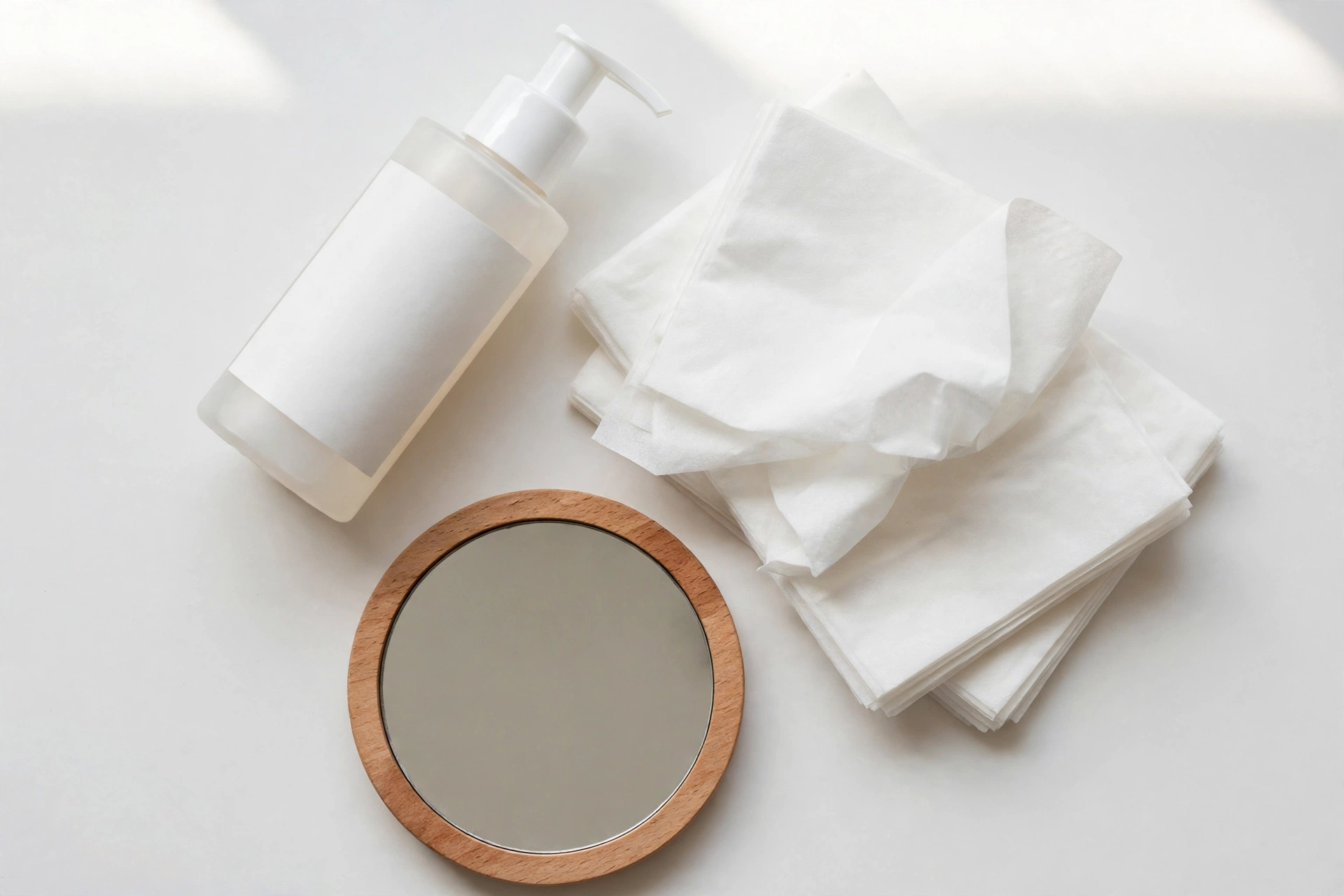
This is the most reliable home test. It watches what your skin does on its own, with no products on it. It takes 30 minutes and needs only a gentle cleanser, a clean towel, a mirror, and a few sheets of plain tissue.
Step 1: Wash your face. Use a gentle cleanser, the mildest one you have. Wash for about 30 seconds with lukewarm water. Do not use a scrub, a strong acid, or a medicated wash for this test. Those change the result.
Step 2: Pat dry. Pat your face dry with a clean towel. Do not rub. Do not put anything on your skin. No toner, no serum, no moisturizer, no sunscreen. Your skin needs to be bare for the test to work.
Step 3: Wait 30 minutes. Do not touch your face. Do not go outside into strong sun or wind. Sit indoors at a normal temperature and wait. This is the hardest part, because it feels like doing nothing. It is the most important part. Your skin needs time to show its natural oil pattern.
Step 4: Look in the mirror. Look at your whole face in good light. Note where it shines and where it looks dry. Then press a clean tissue sheet on your forehead, nose, cheeks, and chin, one area at a time. Look at the tissue. Oil shows up as a translucent spot.
Here is how to read the results:
- Shiny all over, tissue picks up oil everywhere: oily skin.
- Tight, dry, or a little flaky, no oil on the tissue: dry skin.
- Shiny on the forehead and nose, normal or dry on the cheeks: combination skin.
- Red, itchy, or stinging after washing: sensitive skin. This can sit on top of any base type, so note the oil pattern too.
- Fine lines, loss of firmness, and a dull look, often with dryness: mature skin, usually alongside dry skin.
Repeat the test when the seasons change, or when your skin starts behaving differently.
When the Result Is Unclear
Sometimes the test does not give a clean answer. That is normal, and it usually has a simple cause.
Your skin feels tight and looks shiny. This often means the skin is dehydrated, not oily. The barrier is weak, so water escapes, and the skin makes extra oil to compensate. The fix is hydration, not drying products. Use a gentle cleanser, a hydrating toner, and a light moisturizer, and retest in two weeks.
Your skin changes with the seasons. Oily in summer, dry in winter is common. Pick the type for the current season and switch the routine when the season changes. You do not need a new identity, just a seasonal adjustment.
Your skin is reacting to a product. If you started a strong active recently, your skin may be irritated, which looks like sensitivity. Stop the active for a week, use only a gentle cleanser and moisturizer, then retest. The true type often appears once the irritation calms down.
What to Do Once You Know Your Type
Your type points to a routine. The routine has the same four steps for everyone, but the products change.
Oily skin: foaming or gel cleanser, niacinamide serum, light gel moisturizer, matte sunscreen. BHA two to three times a week to keep pores clear.
Dry skin: cream cleanser, hyaluronic acid serum on damp skin, rich cream with ceramides, hydrating sunscreen. Gentle AHA one to two times a week.
Combination skin: one gentle routine for the whole face. BHA only on the T-zone. Richer cream only on dry cheeks.
Sensitive skin: fragrance free products, gentle cleanser, simple moisturizer, mineral sunscreen. One new product at a time, with a patch test first. For sensitive skin, a niacinamide serum at 2 to 5 percent is the safer pick. A 10 percent niacinamide serum should only be used every other day and only after a patch test.
Mature skin: gentle cleanser, vitamin C in the morning, retinol at night used slowly, rich moisturizer, daily sunscreen.
In every case, sunscreen is the most important step. Sun damage causes dark spots, wrinkles, and dullness in every skin type. Use a broad spectrum sunscreen with SPF 30 or higher every morning, even on cloudy days.
Frequently Asked Questions
How do I know my skin type?
Wash your face with a gentle cleanser, pat it dry, and wait 30 minutes with nothing on it. Then look in the mirror and press a clean tissue on your forehead, nose, cheeks, and chin. Shiny all over means oily skin. Tight or flaky means dry skin. Shiny on the forehead and nose with normal cheeks means combination skin.
Can skin type change over time?
Yes. Age, weather, hormones, and products can all shift it. Many people have oily skin in summer and combination or dry skin in winter. Skin often gets drier with age. That is why the test is worth repeating when the seasons change, or when your routine stops working.
What is the T-zone?
The T-zone is the forehead, nose, and chin. These areas have more oil glands than the cheeks, so they shine first in combination and oily skin. The name comes from the T shape these three areas make on the face. In combination skin, the T-zone is oily while the cheeks stay normal or dry.
Is sensitive skin a skin type?
Sensitive skin is a reactivity pattern, not a base type on its own. You can have sensitive oily skin or sensitive dry skin. The sensitivity tells you to keep everything gentle and fragrance free, while the base type tells you which cleanser and moisturizer to use.
Do I need a quiz to find my skin type?
No. The bare face test is more reliable than most quizzes, because it watches what your skin actually does instead of relying on your memory. A quiz can be a starting point, but treat its result as a guess to confirm with the 30 minute test.
Sources and Further Reading
- American Academy of Dermatology (dofollow): skin type basics and daily skin care guidance.
- Cleveland Clinic guide to skincare ingredients (nofollow): how skin types respond to active ingredients.
- CeraVe (nofollow): gentle cleanser and moisturizer product details by skin type.
This article is general information only, not medical advice. If you have a skin condition, are pregnant, or take prescription skincare, talk to a dermatologist before changing your routine.
Related guides
Glowing Skin for Dark Skin: The Safe, Even Glow Guide
How to Get Glowing Skin Naturally at Home: Real Habits
1 thought on “How to Know Your Skin Type: The 30 Minute Test”
Comments are closed.