
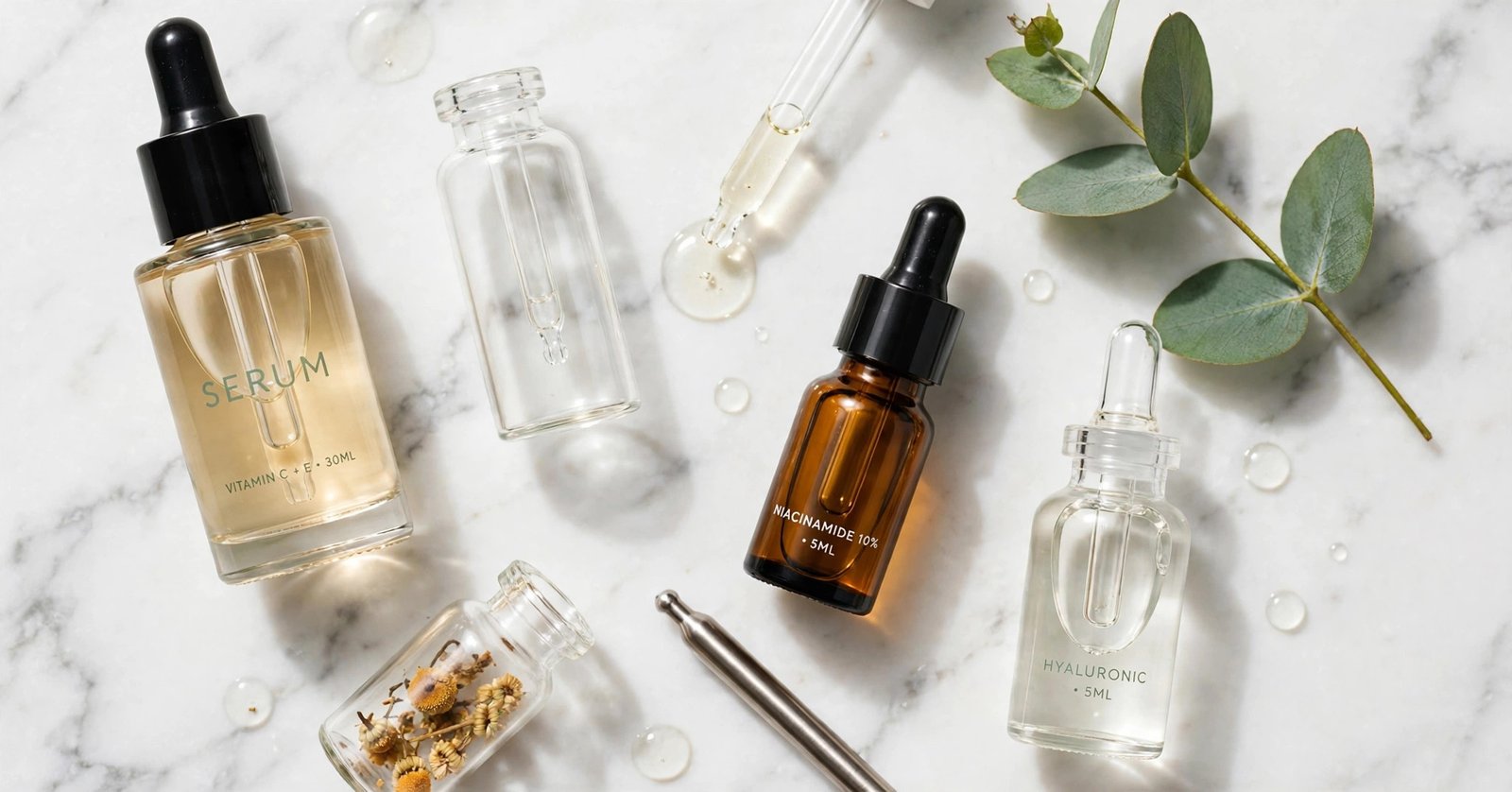
Ingredient labels can feel like a foreign language. Retinol, niacinamide, hyaluronic acid, AHA, BHA. Every bottle promises a different result, and the names all sound the same.
This skincare ingredients explained guide translates the label. You will learn what each active ingredient does, which skin type it suits, how to use it, and what never to mix with it.
The Short Answer
Start with three ingredients: a hydrator (hyaluronic acid), a brightener (vitamin C or niacinamide), and sunscreen. Add retinol later for lines and texture. Add an acid (AHA or BHA) for exfoliation 2 to 3 times a week. Never mix retinol and strong acids on the same night.
What Is an Active Ingredient?
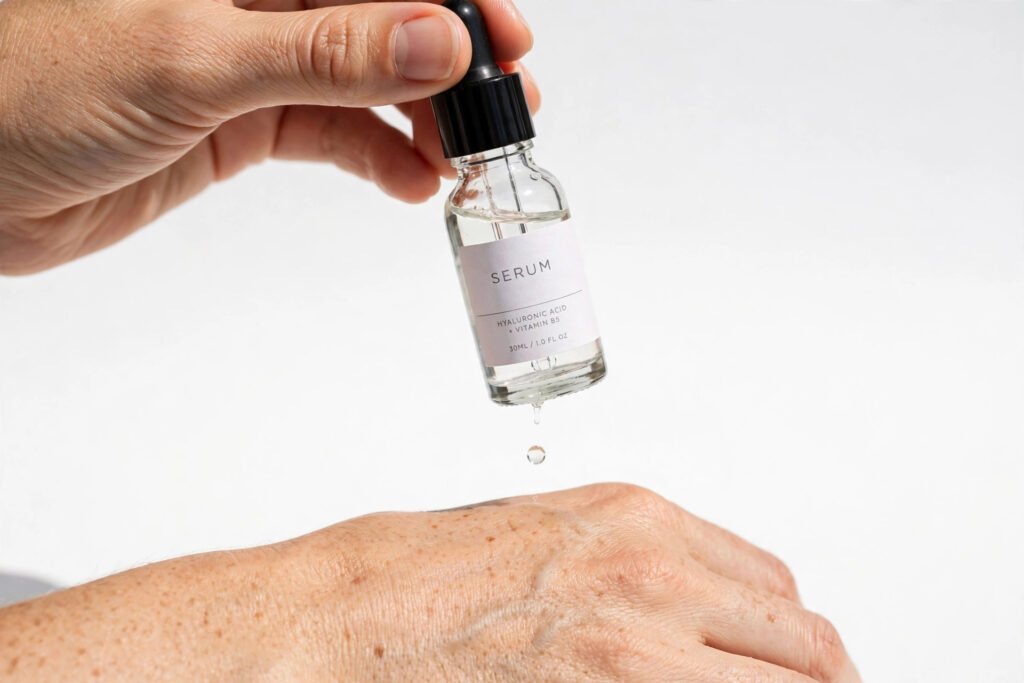
An active ingredient is the part of a product that changes your skin. Everything else in the bottle is a carrier. It holds the active, makes it feel nice, and helps it spread.
For example, in a niacinamide serum, niacinamide is the active. Water, glycerin, and preservatives are the carriers. The active does the work. The carrier just delivers it.
You do not need a product for every active. You need the right active for your main concern.
The Big Seven Actives
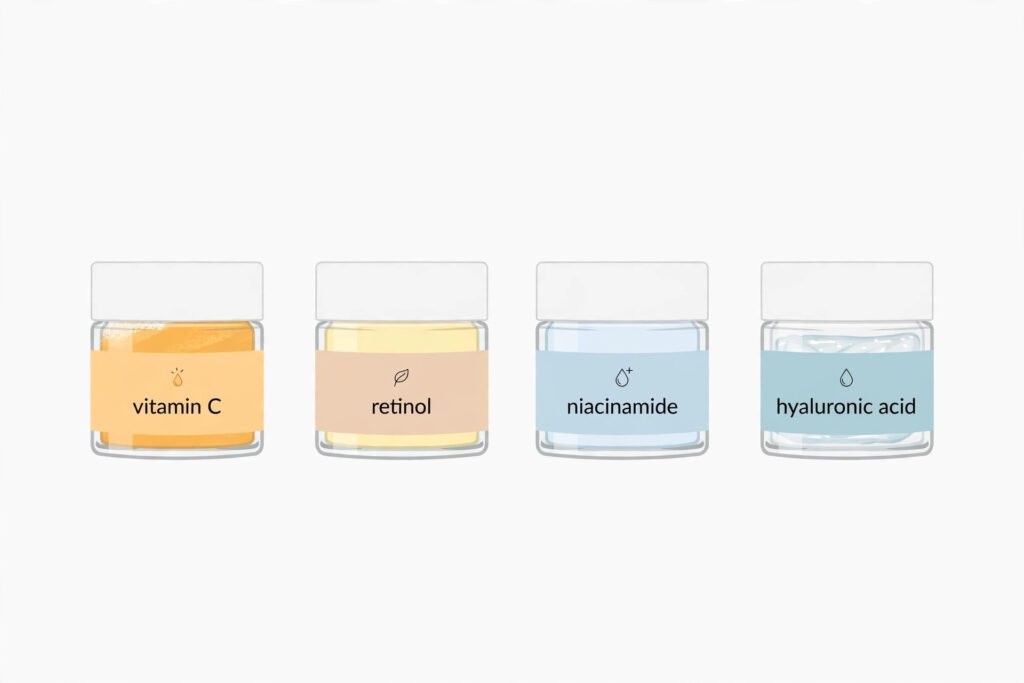
1. Vitamin C
What it does: Brightens dull skin, fades dark spots, and helps your skin make collagen. Collagen is the protein that keeps skin firm. Vitamin C also protects skin from sun damage during the day, but it is not a sunscreen.
Best for: Dull skin, dark spots, uneven tone, mature skin.
How to use it: In the morning, after cleansing and before moisturizer. Use 2 to 4 drops of serum. Follow with moisturizer and sunscreen.
Which form to buy: The Cleveland Clinic guide to skincare ingredients notes that L-ascorbic acid is the only useful form of vitamin C in topical products. Look for L-ascorbic acid at 10 to 20 percent. Other forms, like ascorbyl glucoside, are gentler but weaker. If you have sensitive skin, start with a gentler form.
Watch out: Vitamin C can sting sensitive skin. It can also turn orange or brown when it goes bad. Store it away from light and heat, and replace it if the color changes. Do not use it at the same time as retinol. Use vitamin C in the morning and retinol at night.
2. Retinol
What it does: Speeds up cell turnover. That means old skin cells shed faster and new cells come to the surface. The result is smoother texture, fewer fine lines, clearer pores, and a more even tone. Retinol is one of the most studied ingredients in skincare.
Best for: Mature skin, fine lines, acne prone skin, rough texture.
How to use it: At night only, after cleansing and before moisturizer. Start with a low strength, 0.25 to 0.5 percent. Use a pea sized amount for your whole face. Start 2 to 3 nights a week. Increase slowly over a month.
Watch out: Retinol can cause dryness, redness, and peeling in the first few weeks. This is normal and usually fades. Use a gentle moisturizer and skip other strong actives on retinol nights. Do not use retinol if you are pregnant or breastfeeding. Retinoids are not safe during pregnancy. If you are pregnant, talk to your doctor about bakuchiol or azelaic acid instead.
Drugstore options: The Ordinary Retinol 0.5% in Squalane, about $7. RoC Retinol Correxion Deep Wrinkle Night Cream, about $22. Both are good starting points.
3. Niacinamide
What it does: Niacinamide is a form of vitamin B3. It calms redness, evens skin tone, shrinks the look of pores, and helps the skin barrier hold water. It also helps control oil.
Best for: Almost every skin type. It is especially good for oily, combination, and sensitive skin.
How to use it: Morning or night, after cleansing and before moisturizer. Use 2 to 4 drops. It mixes well with almost everything.
Watch out: Most people tolerate niacinamide well at 2 to 5 percent. Very high strengths, like 10 percent, can sting sensitive skin. If it stings, use it less often or switch to a lower strength. The Ordinary Niacinamide 10% + Zinc 1% costs around $6 and is the most popular drugstore option.
4. Hyaluronic Acid
What it does: Hyaluronic acid pulls water into the skin. It can hold up to 1,000 times its weight in water. The result is plump, hydrated skin with softer fine lines. It works right away, unlike retinol or vitamin C.
Best for: All skin types, especially dry skin.
How to use it: On damp skin, after cleansing and before moisturizer. This is important. Hyaluronic acid pulls water from wherever it can find it. On damp skin, it pulls water into your skin. On dry skin in a dry room, it can pull water out of your skin instead. Always seal it with moisturizer.
Watch out: Very little. Hyaluronic acid is one of the gentlest ingredients. It mixes well with everything.
Drugstore options: Neutrogena Hydro Boost Water Gel, $19.99 at Target (Nov 2026). The Ordinary Hyaluronic Acid 2% + B5, around $9.
5. AHA (Alpha Hydroxy Acids)
What they do: AHAs exfoliate the surface of the skin. They dissolve the glue that holds dead skin cells together, so dull cells shed and fresh skin shows. The most common AHAs are glycolic acid and lactic acid.
Best for: Dull skin, rough texture, dark spots, dry skin. Lactic acid is gentler than glycolic acid and suits sensitive skin better.
How to use it: 2 to 3 times a week, at night, after cleansing. Start with a low strength. Do not use it every day at first.
Watch out: AHAs make skin more sensitive to the sun. Always wear sunscreen the next morning. Do not use an AHA and retinol on the same night. Do not use an AHA and a BHA on the same night either. Pick one exfoliant per night.
6. BHA (Beta Hydroxy Acid)
What it does: BHA is salicylic acid. Unlike AHAs, it goes inside the pore and clears out oil and dead skin. It is the best exfoliant for blackheads and breakouts.
Best for: Oily skin, acne prone skin, clogged pores.
How to use it: 2 to 3 times a week, at night, after cleansing. A 2 percent BHA liquid or gel is the standard strength.
Watch out: BHA can dry skin out if you use it too often. Do not use it on the same night as retinol or an AHA. If your skin gets red or flaky, cut back to once a week.
7. Ceramides
What they do: Ceramides are fats that hold the skin barrier together. Think of the skin barrier as a brick wall. Skin cells are the bricks. Ceramides are the mortar. When the mortar is strong, water stays in and irritants stay out.
Best for: Dry skin, sensitive skin, mature skin, and anyone whose skin feels tight or irritated.
How to use it: In your moisturizer, morning and night. You do not need a separate ceramide serum. A good ceramide moisturizer is enough.
Watch out: Almost nothing. Ceramides are safe for almost everyone, including sensitive skin and pregnant people.
Drugstore options: CeraVe Moisturizing Cream, $15.99 at Target (Nov 2026). It has three ceramides and hyaluronic acid.
Other Ingredients Worth Knowing
| Ingredient | What it does | Best for |
|---|---|---|
| Peptides | Signal skin to make more collagen. Gentle anti aging support. | Mature skin, sensitive skin |
| Azelaic acid | Calms redness, fades dark spots, helps acne. Safe in pregnancy. | Sensitive skin, rosacea prone skin, dark spots |
| Bakuchiol | A plant based retinol alternative. Smooths lines with less irritation. | People who cannot use retinol, sensitive skin |
| Squalane | A light oil that mimics skin’s own oil. Moisturizes without clogging pores. | Dry skin, sensitive skin |
| Glycerin | A humectant that pulls water into skin. Found in most moisturizers. | All skin types |
| Zinc oxide | A mineral sunscreen filter. Sits on skin and blocks UV rays. | Sensitive skin, daily sun protection |
| Panthenol (vitamin B5) | Soothes and hydrates irritated skin. | Sensitive skin, after exfoliation |
A 2019 study in the British Journal of Dermatology found that bakuchiol 0.5 percent gave similar results to retinol 0.5 percent over 12 weeks, with less irritation. It is a good option if retinol is too strong for you or if you are pregnant. Ask your doctor first if you are pregnant.
The Mixing Table: What Goes With What
This is the part most guides skip. Mixing the wrong ingredients can irritate your skin or cancel out the benefits.
| Combination | Verdict | Why |
|---|---|---|
| Vitamin C (morning) + retinol (night) | Safe | Different times of day. No conflict. |
| Niacinamide + almost anything | Safe | Niacinamide mixes well with nearly every active. |
| Hyaluronic acid + almost anything | Safe | It is a hydrator, not an exfoliant. Use it under everything. |
| Ceramides + almost anything | Safe | They repair the barrier. They help other actives feel gentler. |
| Retinol + AHA on the same night | Do not mix | Both exfoliate. Together they cause redness and peeling. |
| Retinol + BHA on the same night | Do not mix | Same reason. Too much exfoliation at once. |
| Retinol + vitamin C at the same time | Do not mix | They work at different pH levels and can irritate skin. Split them by morning and night. |
| AHA + BHA on the same night | Do not mix | Two exfoliants at once is too much. Pick one. |
| Vitamin C + niacinamide | Safe in modern formulas | Old advice said they cancel each other out. Modern stable formulas work fine together. |
| Retinol + peptides | Safe | Peptides are gentle. They can help skin recover from retinol. |
The simple rule: one strong active per night. If you use retinol tonight, skip the acids. If you use an acid tonight, skip the retinol. Use vitamin C in the morning. Use niacinamide and hyaluronic acid any time.
Best Ingredients by Skin Type
| Skin type | Start with | Add later |
|---|---|---|
| Oily | Niacinamide, BHA, hyaluronic acid | Retinol (alternate nights) |
| Dry | Hyaluronic acid, ceramides, lactic acid | Vitamin C, squalane |
| Combination | Niacinamide, hyaluronic acid, BHA on T-zone | Vitamin C in the morning |
| Sensitive | Ceramides, niacinamide, hyaluronic acid | Azelaic acid, bakuchiol |
| Mature | Vitamin C, retinol, peptides, ceramides | AHA for texture, squalane for richness |
Find your skin type first in our guide on how to get glowing skin, then pick from this table.
How to Read an Ingredient Label
Ingredient labels list ingredients from highest amount to lowest. The first five ingredients make up most of the product. If the active you want is listed near the end, there may not be enough of it to work.
Three label tips:
- Look for the active in the top half of the list. If niacinamide is the second ingredient, the product has a real dose. If it is the twentieth, it is mostly marketing.
- Check the percentage when the brand states it. A 10 percent niacinamide serum is stronger than a 2 percent one. Stronger is not always better. Sensitive skin should start low.
- Watch for fragrance. Fragrance is listed as “fragrance” or “parfum.” It adds nothing to results and can irritate sensitive skin. Fragrance free is not the same as unscented. Unscented products can still have masking fragrance. Look for the words “fragrance free” on the label.
How Long Each Ingredient Takes to Work
| Ingredient | First results | Full results |
|---|---|---|
| Hyaluronic acid | Right away | 1 to 2 weeks |
| Niacinamide | 2 to 4 weeks | 8 to 12 weeks |
| Vitamin C | 3 to 4 weeks | 8 to 12 weeks |
| AHA and BHA | 1 to 2 weeks | 4 to 8 weeks |
| Retinol | 4 to 6 weeks | 8 to 12 weeks |
| Ceramides | 1 to 2 weeks | 4 to 6 weeks |
| Azelaic acid | 4 to 6 weeks | 8 to 12 weeks |
Skin renews itself in about 4 weeks. That is why no active shows full results in a few days. Give each ingredient at least a month before you judge it.
Frequently Asked Questions
What is the most important skincare ingredient?
Sunscreen. It prevents the damage that all other ingredients try to fix. After sunscreen, vitamin C, niacinamide, and retinol are the most proven actives.
Can I use retinol and vitamin C together?
Yes, but not at the same time. Use vitamin C in the morning and retinol at night. Using both at once can irritate skin.
What skincare ingredients should never be mixed?
Do not use retinol and strong acids on the same night. Do not use vitamin C and retinol at the same time. Do not layer two strong exfoliants together. One strong active per night is the safe rule.
Is niacinamide safe for everyone?
Niacinamide is one of the gentlest actives. Most people tolerate it well at 2 to 5 percent. Very high strengths can sting sensitive skin. Start low if your skin reacts easily.
How long do skincare ingredients take to work?
Hydrators like hyaluronic acid work right away. Vitamin C and niacinamide take 4 to 8 weeks. Retinol takes 8 to 12 weeks for full results.
Can I use retinol while pregnant?
No. Retinol and other retinoids are not safe during pregnancy or breastfeeding. Use bakuchiol or azelaic acid instead, and ask your doctor first.
The Bottom Line
You do not need to know every ingredient on the label. You need to know the seven in this guide. Start with a hydrator, a brightener, and sunscreen. Add retinol or an acid later, one at a time. Never mix two strong actives on the same night.
Once you know what each ingredient does, you can read any label and decide if a product is worth your money. That is the real skill. Our drugstore dupes guide shows which drugstore products have the best actives for the lowest price, and our beginner skincare routine guide shows how to put them together in order.
This article is general information only, not medical advice. If you have a skin condition, are pregnant, or take prescription skincare, talk to a dermatologist before using a new active ingredient. Read our Disclaimer for the full details. If you have questions about this guide, reach out through our Contact Us page or see our frequently asked questions. Learn more about who we are on our About Us page. Some links on this site are affiliate links, which means we may earn a small commission at no extra cost to you. See our Affiliate Disclosure for details.
Sources and further reading
Cleveland Clinic guide to skincare ingredients
American Academy of Dermatology
CeraVe
The Ordinary
La Roche-Posay
Neutrogena
1 thought on “Skincare Ingredients Explained: The Complete Guide to Actives”
Comments are closed.